
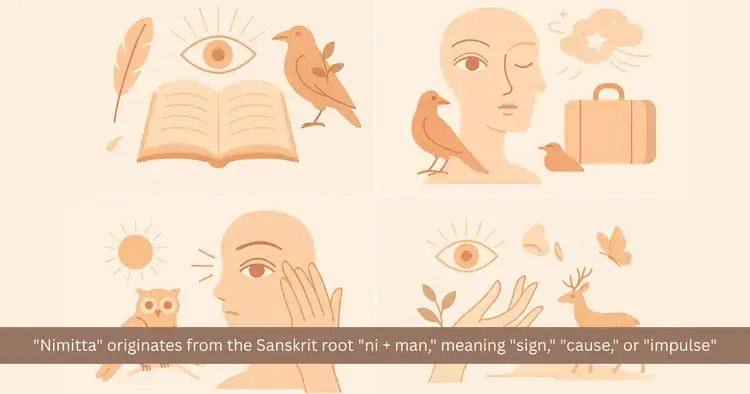
In the ancient Indian tradition, Shakuna Shastra, also known as Nimitta Shastra, is the traditional study of omens, signs, movements, and occurrences that may provide insight into the circumstances surrounding an important action or decision.
Life constantly communicates through subtle signs. The movement of birds and animals, unexpected encounters, sounds, words spoken at significant moments, objects, and certain spontaneous bodily sensations have traditionally been observed as Nimittas—meaningful indications.
Shakuna Shastra teaches us not to live in fear of these signs, but to become more observant, thoughtful, and conscious of the moment.
An unexpected event before beginning an important task does not necessarily mean that something bad will happen.
For example, you are leaving home for an important appointment and accidentally drop your keys. You then reach your car and realize that an important document has been left at home.
Traditionally, such circumstances may be understood as a Nimitta, suggesting that you should pause, reconsider, check your preparation, or proceed more carefully.
The message may not be:
“Do not do this.”
It may instead be:
“Slow down. Pay attention. Something requires your attention before you proceed.”
This is one of the deeper principles of omen interpretation.
Ancient Indian omen traditions also pay attention to certain spontaneous and temporary sensations in the body, including twitching, pulsing, or itching in different parts of the body.
These occurrences can naturally happen for many ordinary reasons. Fatigue, stress, muscle activity, environmental factors, and other physical causes can produce such sensations.
However, when a spontaneous and temporary twitching or itching occurs without an apparent physical explanation, traditional Shakuna and Nimitta practices have sometimes regarded the location and side of the body as symbolically significant.
In certain traditional interpretations:
For men, spontaneous twitching or itching on the right side is generally regarded as favorable.
For women, the left side is traditionally regarded as more favorable.
The opposite side may traditionally be viewed as a cautionary or less favorable indication.
Interpretations can differ among traditional texts, regions, and schools. Therefore, these should be understood as traditional symbolic interpretations rather than universal rules.
The particular body part, timing, circumstances, and question occupying the person’s mind may also be considered in a deeper interpretation.
This distinction is very important.
Not every twitch or itch is an omen. If a person is extremely tired and experiences muscle twitching, it may simply be a natural physical response to fatigue. Persistent itching or other physical symptoms may likewise have ordinary medical or environmental causes.
If a physical symptom is persistent, severe, or concerning, appropriate medical advice should always be sought.
The traditional practice concerns the symbolic interpretation of spontaneous occurrences, not the diagnosis of illness.
Ancient Indian traditions paid close attention to the natural world and the subtle experiences of human life.
Birds, animals, human movements, sounds, directions, unexpected encounters, and spontaneous bodily sensations were observed carefully.
These observations became part of traditional systems associated with Shakuna and Nimitta Shastra.
The deeper philosophy is that we are not completely separate from the world around us. At significant moments, our surroundings—and sometimes our own spontaneous experiences—may provide symbolic indications that invite us to pause, observe, and reflect.
Shakuna Shastra should never be used to create unnecessary fear or superstition.
A wise approach is to observe the sign, understand its traditional meaning, and then use discrimination, practical judgment, preparation, and awareness before making a decision.
An omen may encourage you to:
Recheck your plans
Prepare more carefully
Postpone an action briefly
Look for something you may have overlooked
Be more alert while travelling
Consider another approach
Proceed with greater confidence when the indications are favorable
The purpose is awareness—not fear.
A single ordinary incident should not automatically be treated as a prediction.
Traditional interpretation considers the context, timing, circumstances, repetition, direction, nature of the event, the person’s intention, and the question for which guidance is being sought.
The same sign may have different meanings in different circumstances.
This is why experienced interpretation is important.
Rather than simply asking whether an omen is “good” or “bad,” the deeper question is:
“What is this moment asking me to understand?”
People may seek traditional omen guidance when they are:
Beginning an important journey
Starting a new business or project
Making an important personal decision
Considering a major change
Facing uncertainty about timing
Beginning an important ceremony or undertaking
Experiencing repeated unusual signs or circumstances
Noticing significant spontaneous signs before an important event
Seeking traditional spiritual insight into a particular situation
Shakuna Shastra may be considered alongside common sense, careful planning, personal responsibility, and other traditional Jyotisha methods.
The ancient sages encouraged human beings to observe life with a quiet and attentive mind.
Sometimes the most important message is not the event itself, but the awareness it creates within us.
A delay may give you time to prepare.
A forgotten document may reveal an oversight.
An unexpected encounter may cause you to reconsider your approach.
A favorable sign may strengthen your confidence.
A spontaneous body sign may remind you to become more attentive to the present moment.
Thus, the deeper value of Nimitta is not simply predicting the future. It is learning to recognize the present more clearly.
Experienced Guidance in Traditional Occult Sciences
With 40 years of experience in Vedic Astrology and the study and practice of various traditional occult sciences, I bring decades of learning, observation, and experience to the interpretation of Shakuna Shastra and Nimitta.
My approach is not based on creating fear or making absolute claims about the future. Instead, I seek to understand the traditional significance of the signs surrounding your question and help you approach important situations with greater awareness, clarity, preparation, and confidence.
When you notice a significant omen or an unusual sequence of events, don’t be afraid—pause and understand.
For Shakuna Shastra / Nimitta Guidance, contact me for a personal consultation.